Abrasive flow machining can reach complex internal passages using flexible abrasive media that conforms to the component.
This makes AFM particularly useful when medical-device surfaces are difficult to access with conventional polishing or deburring tools.
Medical Device Finishing Challenges
Small precision components often contain the most difficult finishing problems.
A cross-drilled passage may leave an inaccessible burr. A long lumen may contain machining roughness. An internal edge may need a smooth radius rather than a sharp transition.
AFM allows these surfaces to be approached from inside the part.
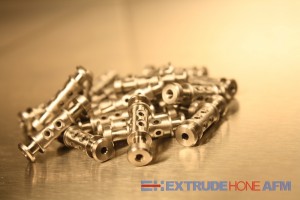 Potential applications include:
- Surgical instruments
- Orthopedic components
- Spinal parts
- Implantable devices
- Diagnostic instruments
- Needles
- Cannulas
- Pumps
- Valves
- Drug-delivery components
Polishing for Improved Surface Condition
Machined surfaces contain peaks, valleys, and microscopic irregularities.
Extrude Hone AFM notes that AFM polishing can reduce surface negatives that may contribute to bacterial contamination.For medical manufacturers, this can improve the underlying part surface before required cleaning, sterilization, and validation steps.
Deburring and Edge Radiusing
Sharp edges are another important medical finishing issue.
Extrude Hone AFM uses AFM to remove burrs and create smooth radii.Its medical guidance specifically notes that smoother, radiused edges can reduce tissue damage where suitable components are introduced into the body.
Because abrasive media travels through the component, AFM can perform this work on internal features that may otherwise be inaccessible.
Charlotte Medical and Precision Manufacturing
Charlotte and the broader Carolinas manufacturing corridor support medical devices, precision machining, aerospace, automotive, advanced materials, and other technical industries.
Companies manufacturing components for healthcare applications can use AFM as a specialized finishing process when ordinary polishing methods are not suitable for the part geometry.
This can be especially useful for low-volume specialized components as well as production parts.
How the Process Is Customized
AFM is highly adjustable.
Extrude Hone AFM can control media flow rate, pressure, viscosity, abrasive concentration, abrasive particle size, and processing cycles.The workpiece's material, hardness, passage dimensions, and starting surface also affect the outcome.
Media options range from very fine honing to aggressive stock removal.
Selective Internal Finishing
Tooling holds the medical component and controls the flow path.
It directs abrasive media to the feature requiring work while protecting other areas.
This can help Extrude Hone AFM preserve critical geometry while improving the target surface.
Medical Metals
AFM can work with titanium, hardened metals, superalloys, aluminum, copper, bronze, and other suitable materials.
Request Charlotte Medical Device Surface Finishing
Call (562) 531-2976 to discuss Charlotte, NC medical components with Extrude Hone AFM.
FAQs
Can AFM finish surgical instruments?
Yes. Suitable surgical and diagnostic instrument components can be polished, deburred, and radiused.
Can AFM work on internal cross holes?
Yes. Internal cross-hole deburring is one of AFM's strongest applications.