Abrasive flow machining is especially effective where burrs occur at internal intersections or inside channels that cannot be reached easily with conventional deburring equipment.
By flowing an abrasive-filled polymer media through selected areas of a component, Extrude Hone AFM can remove unwanted edges while following intricate internal geometry.
Internal Burrs in Fluid-Handling Components
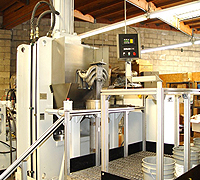 Houston-area manufacturing includes extensive work involving energy, hydraulics, pumps, valves, aerospace, and industrial equipment.
Many components used in these sectors contain interconnected passages that move oil, gas, water, fuel, hydraulic fluid, or air.
Drilling, milling, and other machining processes can create burrs where these passages intersect.
An internal burr may:
- Obstruct part of a flow path
- Create an unwanted sharp edge
- Break loose during operation
- Make cleaning more difficult
- Contribute to inconsistent flow
- Interfere with component performance
The significance depends on the application, but leaving inaccessible burrs untreated is often undesirable.
How Abrasive Flow Deburring Works
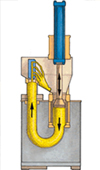
AFM uses viscoelastic polymer media containing abrasive particles.
Tooling directs the media through the selected flow path. As the media squeezes through restricted areas and crosses machined edges, abrasive action removes material from protruding burrs and conditions surrounding surfaces.
The process can be developed to address features such as:
- Cross-hole intersections
- Hydraulic passages
- Valve-body galleries
- Pump flow paths
- Fuel passages
- Complex manifolds
- Internal channels
Because the media follows the passage itself, AFM can reach areas that would require specialized or impractical rigid tooling.
Controlled Edge Conditioning
 Effective flow deburring is not about removing as much material as possible.
The objective is to remove the burr and achieve the required edge condition without unnecessarily altering critical surrounding geometry.
Extrude Hone AFM develops processing conditions based on the workpiece material, burr size, flow path, passage configuration, and desired result.In some applications, the same AFM operation can also improve surface finish along the media path.
A Repeatable Alternative to Difficult Hand Work
Manual deburring can be time-consuming when a component contains multiple internal intersections.
It can also be difficult to inspect or reproduce the same result consistently.
Once Extrude Hone AFM establishes an AFM process for a component, controlled processing can provide a repeatable method for treating production quantities.
That capability can be especially valuable for OEMs and component manufacturers producing complex fluid-handling parts.
Flow Deburring Services for Houston
Extrude Hone AFM has extensive experience applying AFM to internal deburring and polishing across hydraulic, aerospace, automotive, turbine, pump, medical, and other applications.Houston manufacturers can send components to Extrude Hone AFM's Paramount, California facility for processing.
Call (562) 531-2976 to discuss your part, internal burr location, and finishing requirements.
FAQs
Can AFM deburr hydraulic manifolds?
Yes. Hydraulic components containing intricate and intertwined passages are a major application for abrasive flow machining.
Does AFM affect the entire internal passage?
Media contacts surfaces along the controlled flow path. Tooling and process development are used to concentrate the finishing action where required.
Does Extrude Hone AFM serve Houston manufacturers?
Yes. Extrude Hone AFM processes components for customers nationwide.