Abrasive flow machining is particularly valuable in hydraulic applications because these components often contain intricate networks of drilled passages that conventional tools cannot reach completely.
Why Internal Burrs Matter in Hydraulic Systems
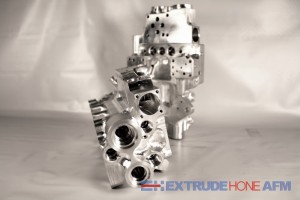 Hydraulic components may operate at substantial pressure.
Inside a manifold or valve body, machining burrs can remain where cross-drilled holes break through into larger passages.
If those burrs are not removed, they may eventually break loose.
Extrude Hone AFM specifically notes that microscopic burrs left inside hydraulic passages can become contamination and contribute to premature failure, especially in high-pressure operation.For systems where fluid cleanliness and reliable operation matter, thorough internal deburring is therefore an important manufacturing step.
How AFM Deburrs Hydraulic Components
Abrasive flow machining forces a viscoelastic polymer media containing abrasive particles through the component.
The media molds itself to the shape of the internal pathway.
As it passes through intersections, abrasive particles contact protruding burrs and sharp edges.
The process can:
- Remove internal burrs
- Finish cross-drilled intersections
- Create controlled radii
- Smooth fluid passages
- Improve internal surface finish
- Reach multiple connected features
- Treat difficult blind or restricted geometry where a flow path can be established
Hydraulic Manifolds With Many Passages
Houston's energy and industrial manufacturing sectors often use complicated valve and manifold bodies.
Some may contain dozens or even hundreds of intersecting holes.
Extrude Hone AFM has specifically addressed hydraulic valve bodies with more than 100 intersections and notes that, with appropriate fixture design, many of these holes can often be deburred and radiused simultaneously.That capability can dramatically simplify a finishing problem that would otherwise require extensive manual work.
Houston Energy and Industrial Applications
Houston's economy includes energy, oilfield equipment, aerospace, pumps, valves, heavy machinery, fluid-control systems, and industrial manufacturing.
Hydraulic components used in these sectors may encounter demanding operating conditions.
AFM can be particularly useful for:
- Hydraulic manifolds
- Oilfield fluid-control bodies
- Industrial valve components
- Pump-related passages
- Mobile-equipment hydraulics
- Aerospace hydraulic parts
- Precision fittings and control blocks
Controlling Edge Condition
The goal is not merely to remove metal.
Extrude Hone AFM develops the process around the specified edge and passage geometry.Tooling directs media through target areas while protecting surfaces where abrasive action is not desired.
Pressure, media viscosity, abrasive concentration, and particle size can then be adjusted to control how quickly material is removed.
Surface Finish and Flow
AFM can simultaneously improve internal surface condition while deburring.
Smoother passages may be desirable in fluid systems where surface roughness or abrupt internal edges affect the quality of the flow path.
Extrude Hone AFM identifies improved surface finish and target radiusing as complementary benefits of hydraulic AFM.Repeatability
Once the proper combination of tooling, media, pressure, and processing cycles has been established, Extrude Hone AFM can monitor stock removal and radius generation for consistency.
That can be valuable for OEMs producing repeated manifold or valve designs.
Request Houston Hydraulic Deburring
Call (562) 531-2976 to discuss your Houston, TX hydraulic component with Extrude Hone AFM.
FAQs
Can AFM deburr high-pressure hydraulic manifolds?
Yes. Hydraulic manifolds are a core AFM application, especially where internal passages are difficult to reach conventionally.
Can AFM process a valve body with many cross holes?
Yes. Complex valve bodies with large numbers of intersections can often be processed through carefully designed flow paths.
Does Extrude Hone AFM serve Houston?
Yes. Extrude Hone AFM provides hydraulic AFM services to manufacturers nationwide.