Abrasive flow machining can polish difficult internal geometry by forcing flexible abrasive media through the component.
Why Flow Surfaces Matter
Pumps and turbines are engineered to move fluids or gases as efficiently as possible.
Rough internal surfaces work against that goal.
Manufacturing buildup, tool marks, or casting texture can increase drag.
Extrude Hone AFM specifically notes that poor surface finish can slow fluid volume through centrifugal pumps. Improving surfaces across the impeller, turbine, and housing can support increased efficiency while reducing unnecessary motor stress.How AFM Finishes Pump and Turbine Parts
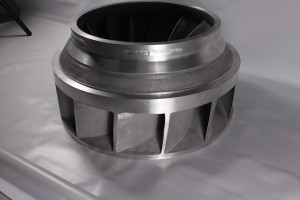 A polymer carrier containing abrasive particles is moved through the component under hydraulic pressure.
The media conforms to the available geometry.
As it moves, the abrasive works on raised surface features.
Potential applications include:
- Impeller blades
- Turbine components
- Pump housings
- Internal passages
- Blade-to-blade channels
- Fluid-flow surfaces
- Gas-flow pathways
- Additive-manufactured components
Indianapolis Manufacturing Applications
Indianapolis and central Indiana support automotive, motorsports, aerospace, industrial machinery, agriculture, transportation, pharmaceutical manufacturing, and precision engineering.
Pumps and turbine-type components may appear throughout these industries.
Industrial and agricultural equipment may depend on fluid movement, while aerospace and engine manufacturing may require highly precise rotating and flow components.
AFM can serve these different applications because the process is developed around the individual part.
Restricted Blade Surfaces
Impeller blades are difficult to polish because their functional surfaces may be hidden deep within narrow spaces.
Extrude Hone AFM specifically highlights its ability to improve surfaces in restricted blade areas.The abrasive media fits the passage rather than requiring the passage to fit a rigid tool.
That makes it possible to treat complex surfaces more uniformly.
Flow Optimization
AFM removes raised material from the flow surface.
In areas where media movement becomes restricted, local velocity and pressure increase, producing a higher material-removal rate.
This can help refine restrictive features that interfere with the intended flow path.
Extrude Hone AFM's existing service content also specifically identifies pumps and turbines as components that may benefit from internal geometry optimization.Additive-Manufactured Components
Metal additive manufacturing can produce turbine, pump, and motor components with complex internal passages.
The same geometry that makes additive manufacturing attractive can make post-processing difficult.
Extrude Hone AFM has used AFM to finish these types of printed parts because abrasive media can reach surfaces that ordinary polishing tools cannot.Process Control
Tooling supports the component, directs media, and protects non-target surfaces.
Additional controls include flow rate, pressure, viscosity, abrasive size, concentration, and workpiece material.
Surface improvement and stock removal can be monitored for repeatability.
Surface Finish Capability
Representative finish improvements include approximately 32 Ra to 8 Ra or better and 64 Ra to 16 Ra or better.
Extrude Hone AFM can process metals ranging from aluminum to titanium, Inconel, and superalloys.Request Indianapolis Turbine and Pump Finishing
Call (562) 531-2976 to discuss turbine and pump flow finishing for Indianapolis, IN with Extrude Hone AFM.
FAQs
Can AFM finish pump components for industrial equipment?
Yes. Suitable impellers, housings, and flow components can be evaluated.
Can AFM be used on aerospace turbine parts?
Yes. Turbine and other complex aerospace flow surfaces are established AFM applications.
Does Extrude Hone AFM serve Indianapolis?
Yes. Extrude Hone AFM provides AFM processing nationwide.