Abrasive flow machining can polish, deburr, and radius complex features by moving abrasive-filled polymer media through internal passages.
Because the media conforms to the component's geometry, AFM is particularly useful for medical parts with small lumens, cross holes, internal channels, and other features that conventional tools cannot easily reach.
Why Medical Parts Need Precision Finishing
Medical-device components can require exceptionally careful surface treatment.
A sharp internal edge may be undesirable in an instrument or implantable device. Burrs may interfere with a fluid pathway. Microscopic roughness can create locations where contaminants may collect.
Extrude Hone AFM specifically identifies deburring, edge radiusing, and polishing as benefits of AFM for medical applications.Medical Components Suitable for AFM
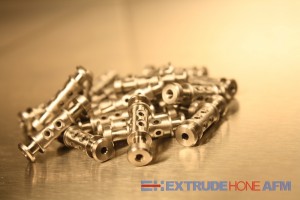 Potential applications include:
- Orthopedic components
- Spinal components
- Surgical tools
- Diagnostic instruments
- Implantable devices
- Needles
- Cannulas
- Pumps
- Valves
- Drug-delivery equipment
AFM can also finish internal lumens and intersecting holes that would be difficult to access through conventional hand finishing.
How AFM Provides Internal Surface Finishing
The process uses a semi-solid, abrasive-laden polymer.
Hydraulic pressure forces this media through selected passages.
As the media passes across the internal surface, abrasive particles remove raised features.
The amount of finishing is controlled through variables including:
- Media viscosity
- Flow rate
- Hydraulic pressure
- Abrasive size
- Abrasive concentration
- Workpiece material
- Passage geometry
Phoenix Medical and Advanced Manufacturing
Phoenix and the surrounding Arizona manufacturing corridor support medical technology, semiconductor manufacturing, aerospace, electronics, and precision machining.
These sectors often overlap in their need for small, highly engineered metal parts.
Medical components may incorporate complex geometry similar to the flow-control and precision parts used in semiconductor and aerospace applications.
AFM provides a finishing method capable of serving these difficult internal surfaces.
Surface Finish and Cleanliness
Smooth internal surfaces can make components easier to clean and reduce microscopic surface features that may retain unwanted material.
Extrude Hone AFM specifically notes that polished medical surfaces can resist bacterial contamination by eliminating surface negatives commonly found after machining.AFM should be viewed as a manufacturing surface-finishing process rather than a substitute for a manufacturer's validated cleaning or sterilization procedures.
Tooling Protects Critical Geometry
AFM tooling holds the component, directs media into the target passage, and protects areas that should not receive abrasive treatment.
This helps Extrude Hone AFM localize the process even on intricate precision parts.
Metals for Medical AFM
The process can be applied to titanium and other hard metals as well as aluminum, bronze, copper, and suitable superalloys.
This versatility makes AFM relevant to a broad range of medical-device materials.
Request Phoenix Medical Device Surface Finishing
Call (562) 531-2976 to discuss medical-device surface finishing for Phoenix, AZ with Extrude Hone AFM.
FAQs
Can AFM finish titanium medical components?
Yes. Titanium can be processed using appropriately developed AFM media and parameters.
Can AFM improve cleanliness?
AFM can reduce roughness, burrs, and microscopic surface irregularities. Cleaning and sterilization remain separate validated manufacturing processes.