Abrasive flow machining uses flexible abrasive media to improve the internal surfaces of intake runners.
The process is particularly useful where bends or enclosed passages prevent traditional porting tools from reaching every surface consistently.
Improving the Intake Flow Path
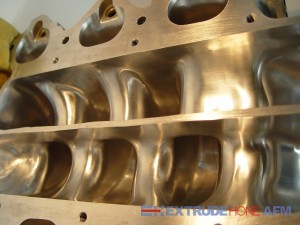 The intake manifold distributes air toward the engine's cylinders.
Its internal geometry can have a major effect on airflow.
Manufacturing or casting may leave roughness, uneven surfaces, burrs, or restricted transitions.
Porting aims to reduce those unnecessary restrictions.
With AFM, abrasive media moves through the same pathway that air follows during engine operation.
The media conforms to the internal shape and removes material from raised or restrictive areas.
Why AFM Instead of Hand Porting?
Hand porting requires direct physical access.
On an open cylinder-head port, that may be practical. In a long or enclosed intake-manifold runner, it may not be.
AFM reaches the internal surface by flowing through it.
Extrude Hone AFM's existing porting information highlights this ability to work on the full passage and avoid the uneven treatment that may occur when hand tools cannot reach all areas equally.Potential Airflow Improvement
In suitable intake-manifold applications, Extrude Hone AFM reports airflow improvements of up to approximately 25 percent.
Improved airflow may support:
- Greater volumetric efficiency
- Increased horsepower
- Improved torque
- More complete combustion
- Better throttle response
Final results depend on the entire engine configuration.
No specific horsepower increase can be promised from intake manifold porting alone.
Inland Empire Automotive Applications
San Bernardino and the Inland Empire have a large automotive community spanning racing, restoration, off-road vehicles, trucks, imports, custom fabrication, motorcycles, and performance street cars.
AFM intake manifold porting may be useful for both modern and older applications.
A rare or discontinued manifold, for example, may benefit from internal improvement when an aftermarket replacement is unavailable.
Custom engine combinations may also use manifolds whose internal geometry makes conventional porting difficult.
Controlled Processing
Extrude Hone AFM determines the appropriate abrasive flow based on the component.Variables include:
- Material
- Runner dimensions
- Abrasive size
- Media viscosity
- Pressure
- Tooling
- Processing cycles
This ensures that the goal remains controlled flow improvement rather than excessive enlargement.
Aluminum and Cast Iron
AFM can be adjusted for different intake-manifold materials.
Aluminum generally requires a lighter abrasive approach than cast iron, which can tolerate more aggressive media.
This flexibility allows Extrude Hone AFM to evaluate both modern and vintage engine components.
Local Southern California Access
San Bernardino-area customers can send components to Extrude Hone AFM's Paramount facility for processing.
That provides Inland Empire customers access to specialized AFM within Southern California rather than requiring the process to be developed in-house.
Request Intake Manifold Porting
Call (562) 531-2976 to discuss your San Bernardino, CA intake manifold and performance goals with Extrude Hone AFM.
FAQs
Can AFM work inside runners that cannot be reached by hand?
Yes. That is one of the strongest reasons to use abrasive flow machining for intake manifolds.
Can vintage manifolds be processed?
Potentially. The material, condition, and geometry must first be evaluated.