Abrasive flow machining is especially useful where important surfaces are buried inside lumens, channels, cross holes, or other internal features.
Flexible abrasive media can move through these areas and provide controlled material removal without requiring direct line-of-sight access.
Finishing Medical Components Beyond the Visible Surface
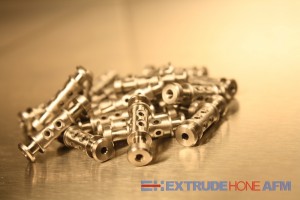 A medical component's most important surface may be inside the part.
Fluid pathways, internal lumens, cross-drilled holes, and small cavities can all require finishing even though a technician cannot directly reach them with a polishing tool.
AFM solves this access problem by using the component's internal passage as the route for the finishing media.
The process can:
- Remove burrs
- Radius sharp edges
- Polish internal surfaces
- Smooth lumens
- Finish cross-drilled intersections
- Improve fluid pathways
- Create repeatable internal finishes
Tissue-Contacting Components
Sharp edges can be problematic when a component is intended to enter or interact with the body.
Extrude Hone AFM's medical guidance notes that deburring and radiusing can contribute to smoother, less destructive introduction into tissue by reducing sharp edges.That makes controlled edge conditioning especially relevant for suitable surgical, orthopedic, implantable, and diagnostic components.
Medical Applications
Possible AFM candidates include:
- Surgical instruments
- Orthopedic components
- Spinal components
- Implantable parts
- Needles and cannulas
- Pumps
- Valves
- Drug-delivery components
- Diagnostic equipment
A recent Extrude Hone AFM medical-device article specifically identifies these types of internal finishing applications.
San Bernardino and Inland Empire Manufacturing
The Inland Empire supports medical, industrial, aerospace, logistics-related, and precision manufacturing operations.
Medical-device suppliers in the region can use Extrude Hone AFM's nearby Southern California AFM facility when highly specialized internal finishing is required.
This can be particularly practical for manufacturers that encounter AFM needs only on certain components and do not want to develop the specialized process internally.
How AFM Is Controlled
Material removal is affected by workpiece hardness and geometry as well as media characteristics.
Extrude Hone AFM can adjust:- Media flow rate
- Pressure
- Media viscosity
- Abrasive particle size
- Abrasive concentration
- Processing cycles
These variables allow the process to be developed around the desired surface improvement or radius.
Selective Finishing With Tooling
Tooling directs abrasive flow into the target surfaces and protects other areas.
That can be especially important for medical components where only an internal passage or specific edge requires finishing while adjacent dimensions must remain unchanged.
Surface Quality and Contamination Concerns
Extrude Hone AFM notes that microscopic surface negatives inherent in machined components can contribute to bacterial contamination.Polishing with AFM can reduce these irregularities.
Manufacturers should still follow all required downstream cleaning, sterilization, validation, and quality procedures for their specific device.
Request San Bernardino Medical AFM
Call (562) 531-2976 to discuss medical device surface finishing for San Bernardino, CA with Extrude Hone AFM.
FAQs
Can AFM polish a small internal lumen?
Yes. Suitable lumens are among the internal medical features that can benefit from AFM.
Can AFM finish only part of a component?
Yes. Tooling can direct media to selected areas while protecting other surfaces.