Abrasive flow machining can reach internal areas that conventional polishing tools cannot easily access by forcing conformable abrasive media through the component.
Why Pumps Benefit From Better Surface Finish
The efficiency of a pump depends partly on how fluid moves across its internal surfaces.
Manufacturing can leave roughness and raised material.
These features create drag.
Extrude Hone AFM explains that poor surface finish in centrifugal pumps can slow fluid volume, while improving the turbine, impeller, and housing surfaces can support increased efficiency and reduce stress on the motor.How AFM Improves Turbine and Pump Components
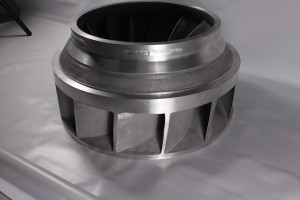 Abrasive particles are suspended in a flexible polymer media.
Hydraulic force pushes the media through the selected portion of the workpiece.
The media conforms to blade geometry and internal passages.
Potential applications include:
- Impeller polishing
- Turbine-surface finishing
- Pump-housing improvement
- Blade-passage polishing
- Internal deburring
- Flow-path refinement
- Surface roughness reduction
Kansas City Industrial Applications
Kansas City supports automotive, aerospace, food processing, agricultural equipment, industrial machinery, transportation, utilities, and manufacturing.
Pumps are used throughout these industries.
Food and process operations rely on fluid movement, agricultural and industrial equipment use pumps for hydraulic and process systems, and aerospace manufacturers may produce turbine-related components.
AFM provides a versatile finishing process across these applications.
Restricted Blade Areas
Impeller surfaces are often difficult to reach because blades are closely spaced and curved.
Extrude Hone AFM specifically highlights the ability of AFM to improve surfaces in restricted areas between blades.Flexible media can conform to these spaces and polish the actual flow path instead of only the externally accessible portions.
Flow-Path Geometry Optimization
Extrude Hone AFM's existing Kansas City AFM material identifies turbines, pumps, manifolds, and hydraulic parts as applications where AFM can optimize internal flow passages.This gives the process an advantage beyond simple cosmetic polishing.
Raised material and restrictive features can be addressed to improve the functional pathway.
Controlled Removal
AFM is adjustable.
Variables include:
- Material type
- Material hardness
- Passage dimensions
- Media-flow rate
- Viscosity
- Abrasive particle size
- Abrasive concentration
- Tooling
Surface Finish Targets
Representative results published by Extrude Hone AFM include approximately:
- 16–8 Ra to 3–4 Ra
- 32 Ra to 8 Ra or better
- 64 Ra to 16 Ra or better
These are examples rather than guaranteed outcomes.
Additive-Manufactured Components
AFM can also improve complex pump and turbine passages created through additive manufacturing.
Extrude Hone AFM specifically identifies SLS-produced turbines, pumps, and motors as parts where internal finishing may be impossible using traditional methods but practical with AFM.Request Kansas City Turbine and Pump Finishing
Call (562) 531-2976 to discuss turbine and pump flow finishing for Kansas City, MO with Extrude Hone AFM.
FAQs
Can AFM finish food-processing pump components?
Suitable metal pump and flow components can be evaluated for AFM according to the application and specifications.
Can AFM improve the geometry of a flow passage?
Yes. Controlled removal of raised and restrictive areas can be used to refine internal flow paths.
Does Extrude Hone AFM serve Kansas City?
Yes. Extrude Hone AFM serves manufacturers throughout the United States.