Abrasive flow machining is especially useful for hydraulic components because the burrs are often located at intersections deep within the workpiece.
AFM uses abrasive-filled polymer media to reach those features from inside the passage.
Why Hydraulic Burrs Can Be Difficult
Machining a hydraulic body frequently requires drilling a network of channels.
When one passage enters another, the machining operation can leave an unwanted edge or burr.
If the intersection cannot be reached from outside the component, conventional deburring becomes difficult.
Traditional methods may remove obvious burrs near openings while leaving microscopic material deeper within the network.
Extrude Hone AFM notes that these remaining burrs may break loose under operating pressure and circulate as contaminants.The AFM Deburring Process
 Abrasive flow machining uses pressure or hydraulics to move abrasive-laden media through the workpiece.
The media has a flexible, putty-like consistency and conforms to the internal passage.
As it flows, it works against raised surface features.
This allows AFM to:
- Deburr intersecting passages
- Remove cross-hole burrs
- Radius sharp edges
- Smooth hydraulic pathways
- Reach internal corners
- Improve surface finish
- Process multiple connected features
AFM is commonly used when manual deburring cannot provide consistent access.
Manifolds as a Primary Application
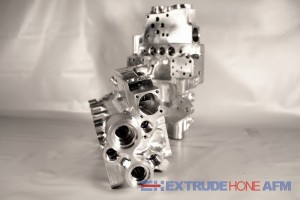
Hydraulic manifolds are particularly well suited to abrasive flow machining.
Their passage networks are often the most difficult area to finish manually.
Extrude Hone AFM's hydraulic FAQ describes successful processing approaches for valve bodies containing over 100 intersecting holes.With the right fixture, abrasive media can often travel through numerous passages and deburr many intersections during the same setup.
Nashville Manufacturing Applications
Middle Tennessee supports automotive, industrial machinery, manufacturing, aerospace suppliers, construction equipment, and other industries that use hydraulic systems.
Components may be installed in production machinery, mobile equipment, transportation systems, or fluid-control applications.
For manufacturers producing these parts, complete internal deburring can be an important quality step.
Edge Radiusing and Surface Finish
AFM can also provide controlled radiusing.
An internal intersection may need a smoother edge to satisfy engineering requirements.
Extrude Hone AFM states that hydraulic AFM can target both surface-finish improvement and desired radii while remaining within blueprint tolerances when the process is properly planned.Material Removal Control
Several variables determine how aggressively AFM works.
These include tooling, pressure, media viscosity, abrasive concentration, abrasive size, workpiece hardness, and passage dimensions.
Extrude Hone AFM's broader process guidance explains that restricted areas see increased media speed and pressure, which can create higher local material-removal rates.That behavior can be used deliberately during process development.
Repeatability
Once the correct parameters have been identified, material removal and radius generation can be monitored for repeated production parts.
This provides another advantage over highly manual internal finishing.
Request Nashville Hydraulic Deburring
Call (562) 531-2976 to discuss hydraulic component deburring for Nashville, TN with Extrude Hone AFM.
FAQs
Is a hydraulic manifold a good AFM application?
Yes. Manifolds are among the strongest uses for AFM because they contain intertwined internal passages.
Can AFM improve the surface as well as remove burrs?
Yes. Deburring, surface improvement, and edge radiusing can often be combined.
Does Extrude Hone AFM serve Nashville?
Yes. Extrude Hone AFM serves hydraulic manufacturers nationwide.