Abrasive flow machining can reach hidden intersections using a flexible abrasive media that flows through the component.
This makes the process particularly useful for high-pressure hydraulic systems where residual internal burrs may create contamination concerns.
Hydraulic Manifolds Create Difficult Deburring Problems
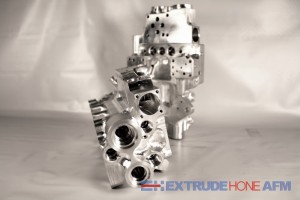
A hydraulic manifold may contain a dense network of drilled channels.
The manufacturing process can create burrs where one passage intersects another.
Many of those locations are physically inaccessible after machining.
Traditional deburring may therefore reach some surfaces while missing others.
Extrude Hone AFM notes that microscopic burrs left behind can later break free in operation, contaminating the system and potentially contributing to premature failure.AFM Follows the Passage Network
 Abrasive flow machining uses a viscoelastic media containing abrasive particles.
Hydraulic force moves the media through the workpiece.
Because the media conforms to the flow path, it contacts internal edges and raised surface features.
AFM can be used to:
- Remove internal burrs
- Finish cross-drilled holes
- Radius intersections
- Smooth passages
- Reach intertwined flow networks
- Improve internal surface condition
- Process multiple features in a single setup
Processing Highly Complex Components
Extrude Hone AFM's hydraulic FAQ specifically addresses a valve body with more than 100 intersecting holes.Through purpose-built tooling, media can be routed through the component so that a majority of the intersections may often be deburred and radiused simultaneously.
That illustrates why AFM is especially valuable for components whose complexity makes conventional deburring impractical.
Pittsburgh Hydraulic and Industrial Manufacturing
Pittsburgh has a long industrial history and today supports advanced manufacturing, energy, robotics, heavy equipment, materials processing, automation, and precision machining.
Hydraulic systems remain important throughout many of these industries.
Manifolds and valve bodies may serve production equipment, mobile machinery, test systems, energy applications, or automated systems.
Extrude Hone AFM provides a specialized process for reaching the internal features in these parts.Tooling Controls Where AFM Works
Fixtures serve several functions.
They hold the workpiece, direct abrasive media through the target passage, and protect areas where abrasion is not desired.
This is particularly important when only specific intersections need to be processed or when multiple passage groups require different flow conditions.
Controlling Material Removal
Extrude Hone AFM controls AFM using media pressure, carrier viscosity, abrasive size, concentration, and tooling.Its hydraulic guidance identifies pressures ranging from about 200 to 2,000 psi and a broad range of abrasive particle sizes.
These variables allow the process to range from light edge conditioning to more substantial material removal.
Meeting Specified Radii
Many hydraulic drawings call out an edge radius.
AFM can be developed specifically to create that condition.
Extrude Hone AFM states that it can target the desired radius and improve surface finish while remaining within component blueprint tolerances when appropriate planning occurs before production.Repeatable Production
The AFM process allows surface finish, stock removal, and radius generation to be monitored for repeatability.
This makes it suitable for both specialized hydraulic components and ongoing production.
Request Pittsburgh Hydraulic Component Deburring
Call (562) 531-2976 to discuss hydraulic deburring for Pittsburgh, PA with Extrude Hone AFM.
FAQs
Can AFM deburr hydraulic parts used in heavy equipment?
Suitable manifolds, valve bodies, and other internal fluid-control components can be evaluated for AFM.
Can the process handle very complex passage networks?
Yes. Complex intertwined passage systems are among the primary reasons hydraulic manufacturers use AFM.