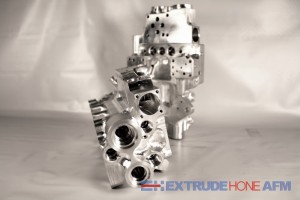
Abrasive flow machining is particularly valuable when the hydraulic component contains intertwined geometry that conventional deburring tools cannot access consistently.
Internal Hydraulic Burrs
Hydraulic passages are frequently created by drilling holes that intersect inside a metal block.
The resulting edge at the intersection may contain a burr.
Because the feature is buried inside the component, an operator may have no direct path for a hand tool.
Extrude Hone AFM notes that traditional deburring often does not reach all parts of a hydraulic passage equally and may leave behind microscopic burrs. Under pressure, those burrs can break free and contaminate the system.Using AFM to Reach the Passage
 Abrasive flow machining moves a flexible abrasive polymer through the component using hydraulic pressure.
The media conforms to the geometry of the passage.
As it crosses a sharp edge or raised machining feature, abrasive action removes material.
AFM can provide:
- Cross-hole deburring
- Internal intersection finishing
- Controlled edge radiusing
- Passage polishing
- Finishing of intertwined channels
- Repeatable material removal
Manifolds With Extensive Passage Networks
Extrude Hone AFM has documented hydraulic valve-body applications containing more than 100 intersecting holes.Custom fixtures can establish a flow path that allows many of those intersections to be deburred and radiused simultaneously.
For passages that do not receive equal flow naturally, tooling can isolate sections or create separate processing routes.
Denver and Front Range Hydraulic Applications
Colorado's Front Range supports aerospace, energy, industrial equipment, mining-related technology, automation, transportation, and advanced manufacturing.
Hydraulic systems are common throughout many of these sectors.
Components used in aerospace or industrial automation can require particularly precise internal finishing.
AFM gives manufacturers a specialized process for reaching those hidden surfaces.
Controlling the Radius
An engineering drawing may specify the geometry at a passage intersection.
Simply knocking off a burr may not be sufficient.
AFM can continue removing material in a controlled manner until a desired radius is produced.
Extrude Hone AFM emphasizes the ability to target radii and improve internal surface finish while remaining within blueprint tolerances when proper planning is performed.AFM Process Variables
Material removal depends on the component and media.
Important factors include:
- Workpiece type
- Material hardness
- Passage size
- Media flow rate
- Media viscosity
- Abrasive size
- Abrasive concentration
Restricted flow areas experience higher speed and pressure, which increases local material-removal action.
Tooling is designed around this behavior.
Repeatability
The AFM process allows stock removal, surface finish, and radius generation to be monitored and repeated across production parts.
That can provide more consistency than manually attempting to reach internal intersections.
Request Denver Hydraulic Deburring
Call (562) 531-2976 to discuss hydraulic component deburring for Denver, CO with Extrude Hone AFM.
FAQs
Can AFM process hydraulic parts used in aerospace?
Yes. Aerospace hydraulic systems are an established AFM application.
Is AFM suitable for very complicated manifolds?
Yes. Complex intertwined passage networks are one of the primary reasons manufacturers use AFM.
Does Extrude Hone AFM serve Colorado?
Yes. Extrude Hone AFM provides nationwide hydraulic component finishing.