Abrasive flow machining can reach surfaces that may be inaccessible to brushes, files, cutters, and other conventional deburring tools. By directing abrasive media through selected areas of the component, Extrude Hone AFM can remove unwanted burrs while also conditioning edges and improving surface consistency.
This combination of access and control makes AFM valuable for precision manufacturing applications where component geometry leaves little room for inconsistent finishing.
Burr Removal Where Access Is Limited
 A machined component does not need to be large or complicated externally to contain a difficult deburring problem.
A small internal cross hole, narrow channel, or intersecting passage may create an edge that cannot be reached directly once machining is complete.
These situations occur in components used throughout medical technology, aerospace, instrumentation, fluid control, and advanced manufacturing.
AFM is designed for exactly this type of problem.
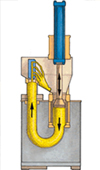
The abrasive media conforms to the space through which it flows, allowing it to reach edges and surfaces that a rigid tool cannot easily follow.
What Can Flow Deburring Accomplish?
Depending on the component and process specifications, abrasive flow machining can be used to:
- Remove internal machining burrs
- Deburr cross holes and intersections
- Radius sharp internal edges
- Smooth flow passages
- Improve consistency between components
- Reduce manual finishing requirements
- Reach multiple internal features
This is especially useful where component reliability or cleanliness depends on removing unwanted material from inside the part.
Flow Deburring for Boston Precision Industries
 The greater Boston region has a substantial concentration of medical device, biotechnology, aerospace, electronics, research, and advanced manufacturing companies.
Many of these industries rely on small, highly engineered components with tight dimensional and surface requirements.
Traditional hand deburring can be difficult when the component contains tiny passages or features located deep within the workpiece.
Extrude Hone AFM offers a specialized alternative by developing AFM processes around the customer's part geometry and required edge condition.Consistency Matters in Precision Deburring
Removing a visible burr from one component may be straightforward. Producing the same edge condition repeatedly across dozens, hundreds, or thousands of components is a different challenge.
Once an AFM process has been developed and controlled, abrasive flow machining can provide repeatable treatment of the same features from one component to the next.
This can be particularly valuable for precision production in which inconsistent manual deburring introduces unnecessary variation.
Extrude Hone AFM considers media type, abrasive characteristics, tooling, flow direction, workpiece material, and processing conditions when developing the process.Is AFM Right for Your Component?
AFM is best evaluated using the actual component requirements.
Factors such as passage access, burr location, material, desired edge radius, and surrounding geometry all affect process feasibility.
Extrude Hone AFM can review drawings, parts, or project specifications to determine whether flow deburring is appropriate.Call (562) 531-2976 to discuss Boston, MA flow deburring services and request a quote.
FAQs
Is AFM suitable for medical components?
It can be. Abrasive flow machining is used for deburring, polishing, and radiusing appropriate medical components.
Can AFM reach narrow internal passages?
Yes, provided the media can be properly directed through the feature and the geometry is suitable for processing.