Abrasive flow machining uses a flexible abrasive media that passes through internal passages, smoothing surfaces and selectively removing material where the flow path creates restriction.
The process has been used in automotive applications for decades and can be adapted for many engine configurations, including gasoline and diesel engines, turbos, hemis, and a variety of cylinder counts.
Improving Internal Engine Passages
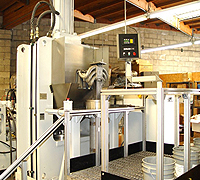 Engine components often contain complex internal pathways that are difficult to polish uniformly by hand.
Casting texture, abrupt transitions, and internal irregularities can contribute to restriction.
AFM approaches the passage from the inside.
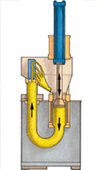
A polymer media containing abrasive particles is hydraulically moved through the component. The media bends and conforms as it travels, allowing abrasive action to occur along internal walls that might not be accessible with conventional tools.
Automotive AFM Applications
Extrude Hone AFM can evaluate components such as:- Intake manifolds
- Exhaust manifolds
- Turbo impellers
- Turbo housings
- Pumps
- Cylinders and associated passages
- Airflow components
- Fuel pathways
- Other suitable engine parts
The intake manifold is particularly important because it distributes air, and in some configurations fuel, toward the cylinders.
Extrude Hone AFM identifies intake-manifold processing as one of the most effective individual automotive AFM applications.Supporting Better Engine Flow
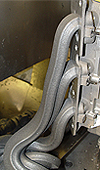 The purpose of automotive AFM is not simply to make the inside of a component look polished.
The goal is to reduce unnecessary restriction and improve how efficiently air or fuel moves through the passage.
Extrude Hone AFM reports that suitable automotive applications may see flow improvements of up to 25 percent. Improved flow can support better volumetric efficiency and may contribute to gains in horsepower, torque, and overall engine responsiveness depending on the complete engine setup.These results should be considered application-specific. AFM cannot compensate for every limitation elsewhere in an engine system, and each component must be evaluated individually.
Atlanta Automotive and Performance Applications
Atlanta has a substantial automotive market that includes restoration, performance tuning, racing, specialty fabrication, diesel work, and general engine machining.
For builders who already optimize heads, intake systems, exhaust components, or forced-induction systems, AFM can provide another method for addressing difficult internal passages.
It may also be useful when a component is valuable, rare, custom, or difficult to replace and conventional porting does not provide practical access.
Process Control for Different Materials
The same abrasive formulation is not used for every part.
Aluminum manifolds behave differently from cast-iron components, and turbo or diesel applications may present different passage geometries from naturally aspirated gasoline engines.
Extrude Hone AFM can vary abrasive characteristics, media, pressure, and tooling to suit the component.Consistency and Flow Matching
AFM can also support more consistent treatment between similar passages or components.
Because processing variables can be controlled, a developed AFM process can be repeated rather than relying entirely on hand-finishing technique.
Request Automotive AFM in Atlanta
Call (562) 531-2976 to discuss your Atlanta, GA automotive component with Extrude Hone AFM. Information about the engine, part, material, and performance goals can help determine whether AFM is a suitable option.
FAQs
Can AFM improve a diesel engine component?
Yes. Diesel engine applications are among the automotive configurations suitable for evaluation.
Is AFM only for racing?
No. Although performance and motorsports applications are common, AFM can be used whenever improved internal passage condition is valuable.
Does Extrude Hone AFM serve Atlanta?
Yes. Automotive parts can be sent to Extrude Hone AFM's Paramount, California facility for processing.