Abrasive flow machining uses a flexible polymer media containing abrasive particles. By directing this media through selected areas of a workpiece, Extrude Hone AFM can smooth internal surfaces that may be inaccessible to conventional polishing equipment.
The process is used across aerospace, automotive, medical, hydraulic, tooling, and other precision manufacturing applications.
Polishing Complex Geometry With AFM
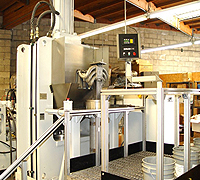 Traditional polishing usually requires direct physical access to the surface. A polishing wheel, stone, brush, or hand tool must be able to contact the workpiece.
That is not always practical when a component contains internal channels, intersecting passages, small openings, or irregular shapes.
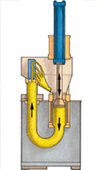
AFM uses the passage itself to guide the polishing medium.
The abrasive media conforms to the internal geometry as it moves, allowing it to contact raised features across the surface and gradually improve the finish.
Tooling helps establish the correct flow path and prevents unwanted finishing in areas that should remain unaffected.
Benefits of Flow Polishing
Depending on the component, AFM can provide:
- Smoother internal passages
- More uniform surface conditions
- Finishing of restricted-access geometry
- Reduction of machining marks and raised surface features
- Controlled edge conditioning
- Internal deburring during the polishing process
- Repeatable results across identical parts
This makes abrasive flow machining useful for both individual precision components and recurring production work.
Atlanta Manufacturing Applications
 Atlanta and the surrounding region support aerospace, transportation, medical technology, industrial equipment, and advanced manufacturing operations.
Components serving these industries may depend on controlled airflow or liquid flow through intricate pathways. Other applications may require a smooth surface for cleanliness, reduced friction, precision fit, or subsequent manufacturing steps.
Extrude Hone AFM develops flow polishing processes around the actual component rather than applying a generic polishing treatment.What Determines the Final Finish?
Several variables influence how much material AFM removes and how smooth the resulting surface becomes.
These include the workpiece material, passage geometry, starting finish, abrasive characteristics, media viscosity, flow restriction, and processing conditions.
For suitable applications, Extrude Hone AFM reports examples of surfaces around 16–8 Ra being improved to approximately 3–4 Ra, while 32 Ra surfaces may be improved to 8 Ra or better.
The actual achievable finish must be determined for the individual component.
Polishing Many Types of Metal
AFM can be used with materials ranging from aluminum, bronze, and copper to hardened metals, titanium, Inconel, and other superalloys.
This versatility makes the process useful for manufacturers working with both conventional and difficult-to-machine materials.
Discuss Your Atlanta Flow Polishing Project
If your component contains internal surfaces that are difficult to polish conventionally, Extrude Hone AFM can review the workpiece and determine whether abrasive flow machining is an appropriate solution.
Call (562) 531-2976 to discuss flow polishing for Atlanta, GA and request a quote.
FAQs
Is flow polishing only for round passages?
No. Because the media conforms to the flow path, AFM can be used on many complicated shapes and internal geometries.
Can polishing and deburring happen during the same process?
Depending on the application, yes. Abrasive flow machining can smooth surfaces while also removing burrs and conditioning edges.
Does Extrude Hone AFM serve Atlanta manufacturers?
Yes. Components can be sent to Extrude Hone AFM's Paramount, California facility for processing.