Abrasive flow machining offers a controlled alternative to conventional hand porting by forcing abrasive-filled polymer media through the internal runners of the intake manifold.
The media follows the internal geometry and removes material from rough and restrictive areas while smoothing passage surfaces.
For manifolds with enclosed runners, tight bends, or difficult internal access, this can provide a substantial advantage over methods that depend on line-of-sight tool access.
What Intake Manifold Porting Is Designed to Improve
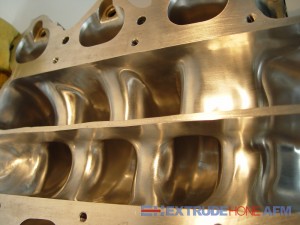 The intake manifold is responsible for delivering incoming air toward the cylinders.
Its effectiveness depends not only on runner size, but also on internal shape, transitions, surface condition, and consistency.
Common issues can include:
- Rough cast surfaces
- Uneven internal passages
- Abrupt transitions
- Minor burrs
- Restrictions
- Differences between runners
Porting seeks to improve those conditions without simply enlarging every passage.
AFM can smooth the internal surface and selectively remove material where the media encounters greater restriction.
Why AFM Is Different
A hand-porting technician uses a grinder or similar tool to physically shape the accessible portions of the manifold.
This approach is limited by where the tool can reach.
AFM instead uses the manifold itself as the pathway for the tool.
The abrasive media flows through the runner, adapting continuously to the passage shape.
Extrude Hone AFM developed its automotive AFM expertise around this concept, and existing company porting pages emphasize that the process can improve the entire accessible passage rather than only exposed sections.Airflow and Engine Performance
Extrude Hone AFM reports that intake-manifold AFM can increase flow by up to approximately 25 percent in suitable applications.Improved manifold flow may support:
- Better volumetric efficiency
- Increased horsepower
- Increased torque
- Improved combustion
- More consistent cylinder filling
The actual engine result depends on far more than the intake manifold.
Cylinder-head flow, camshaft design, engine displacement, exhaust restriction, fuel delivery, forced induction, and tuning all affect performance.
For that reason, Extrude Hone AFM does not promise a specific horsepower increase solely from intake manifold porting.
Boston Automotive Applications
The greater Boston region includes performance shops, classic-car specialists, motorsports enthusiasts, exotic and European specialists, restoration businesses, and precision machining operations.
AFM can be particularly useful when a manifold is rare or difficult to replace.
A restoration project may need to retain an original casting while still improving its internal condition. A custom engine may use a manifold for which conventional aftermarket upgrades are unavailable.
In these situations, porting the existing component may provide a valuable option.
Consistency Between Runners
One important objective is runner consistency.
If the internal condition differs substantially from one passage to another, airflow distribution may also differ.
AFM can provide a repeatable polishing and material-removal process throughout the selected flow paths.
Extrude Hone AFM can also repeat established processing parameters on similar manifolds or components.Controlled Material Removal
The AFM process is developed using variables such as media viscosity, abrasive particle size, concentration, hydraulic pressure, tooling, and number of cycles.
For automotive flow applications, Extrude Hone AFM notes that material removal can reach approximately 1 millimeter, or .040 inch, where appropriate.
The amount actually removed depends on the component.
Request Boston Intake Manifold Porting
Call (562) 531-2976 to discuss intake manifold porting for Boston, MA. Extrude Hone AFM can review your manifold and determine whether abrasive flow machining fits the application.
FAQs
Can AFM port a manifold that is difficult to reach with a grinder?
Yes. Difficult internal access is one of the primary reasons to use abrasive flow machining.