Abrasive flow machining uses flexible abrasive media to follow the internal flow path and remove burrs that conventional tools may not reach.
Why Hydraulic Manifolds Are Difficult to Deburr
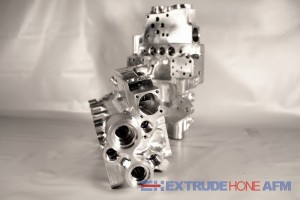
A manifold distributes hydraulic fluid through numerous connected passages.
Machining those pathways frequently involves cross drilling.
Where one hole meets another, a burr or sharp edge can remain.
The more complex the manifold becomes, the harder it is to reach every intersection manually.
Extrude Hone AFM notes that traditional deburring may leave microscopic burrs within these passages. Those burrs can break loose under pressure and become contaminants within the hydraulic system.AFM Deburrs From Inside the Passage
 During abrasive flow machining, a polymer media carrying abrasive particles is hydraulically forced through the component.
The media molds itself to the internal passage.
Abrasive particles contact protruding features and gradually remove them.
The process can be used for:
- Hydraulic manifolds
- Valve bodies
- Mobile-equipment components
- Cross-drilled holes
- Hydraulic fittings
- Pump-control parts
- Industrial fluid components
Many Intersections, One Controlled Process
Extrude Hone AFM has documented components containing more than 100 intersecting holes.With an appropriately designed fixture, abrasive media can often travel through many passages during the same setup, allowing numerous intersections to be deburred and radiused together.
This is one of AFM's biggest advantages for complex hydraulic parts.
Charlotte-Area Hydraulic Applications
Charlotte and the broader Carolinas manufacturing corridor support automotive, aerospace, construction equipment, industrial machinery, energy, transportation, and heavy-equipment production.
Many of these industries rely heavily on hydraulic systems.
Mobile-equipment manifolds, machine controls, hydraulic valve blocks, and fluid-distribution components may all contain complex internal passage networks.
Extrude Hone AFM can provide the specialized finishing required for these areas.Edge Radiusing
Some hydraulic intersections need a defined radius rather than simply being burr-free.
AFM can continue conditioning the edge until the required smooth transition is achieved.
Extrude Hone AFM specifically identifies target radius generation as a key hydraulic capability and notes that the process can remain within specified tolerances when properly planned.Controlling the Process
Primary variables include tooling, media-flow pressure, viscosity, abrasive concentration, and abrasive particle size.
Extrude Hone AFM's hydraulic FAQ identifies media pressure capabilities between approximately 200 and 2,000 psi.The company's broader process guidance also identifies material hardness, passage size, flow rate, and media characteristics as factors influencing material removal.
Repeatability for OEM Production
Hydraulic manufacturers producing the same valve body or manifold repeatedly need consistent results.
AFM allows surface-finish improvement, radius generation, and stock removal to be monitored once a process is established.
This can reduce the variability associated with hand deburring.
Request Charlotte Hydraulic Component Deburring
Call (562) 531-2976 to discuss hydraulic deburring for Charlotte, NC with Extrude Hone AFM.
FAQs
Can AFM deburr hydraulic components used in mobile equipment?
Yes. Suitable manifold and valve components can be evaluated regardless of their final equipment application.
Can AFM create smooth passage intersections?
Yes. The process can combine burr removal with controlled radiusing.