Abrasive flow machining uses flexible abrasive media to reach complex passage geometry and restricted blade surfaces that may be difficult to polish using conventional tools.
Why Pump Components Need Precise Finishing
Pumps work by transferring energy to moving fluid.
The condition of the internal flow surface can influence how efficiently that happens.
Rough manufacturing surfaces create friction and drag.
Extrude Hone AFM specifically explains that poor surface finish and positive material buildup in centrifugal pumps can slow the volume of fluid being moved. Improving the impeller, turbine, and housing surfaces can support better flow efficiency and reduce stress on the motor.AFM Applications for Pumps and Turbines
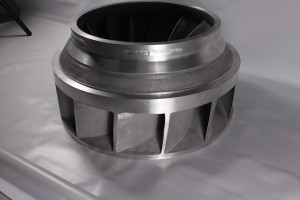 Suitable components may include:
- Centrifugal-pump impellers
- Turbine components
- Pump housings
- Blade passages
- Internal flow channels
- Gas passages
- Precision rotating components
- Additive-manufactured flow parts
The process may combine polishing, burr removal, and geometry refinement.
Charlotte-Area Manufacturing Applications
Charlotte and the Carolinas support aerospace, energy, power generation, industrial machinery, automotive manufacturing, water systems, and precision engineering.
Pumps, turbines, compressors, and rotating equipment are important throughout many of these sectors.
Manufacturers may produce components for energy systems, industrial processing, cooling, transportation, or specialized machinery.
AFM can provide internal surface finishing when blade geometry or passage complexity makes conventional polishing impractical.
Finishing Blade-to-Blade Passages
Curved impeller blades create narrow and complicated flow pathways.
Abrasive media can conform to those passages.
Extrude Hone AFM specifically highlights its ability to remove material from restricted areas between blades while uniformly finishing the overall pump or turbine component.This is one of the strongest advantages of AFM in rotating flow equipment.
Geometry and Flow Behavior
A smoother surface can reduce roughness, but AFM may also improve the shape of restrictive flow areas.
Existing Extrude Hone AFM AFM content identifies pumps and turbines among the components where passage geometry can be optimized to improve fluid or gas behavior.
Because abrasive action increases where flow is restricted, AFM can naturally concentrate material removal in tighter regions.
Tooling Provides Control
Custom fixtures support the component and determine how abrasive media travels.
They can also protect surfaces that should not receive abrasive flow.
This helps preserve required dimensions while concentrating finishing action on the functional surfaces.
Surface Finish Targets
Extrude Hone AFM publishes representative improvements such as approximately 16–8 Ra to 3–4 Ra, 32 Ra to 8 Ra or better, and 64 Ra to 16 Ra or better.Actual results depend on geometry, material, and starting surface.
Materials and Production
AFM can be used on titanium, Inconel, superalloys, hardened materials, aluminum, bronze, copper, and other metals.
Once a process is developed, finish and material removal can be monitored for repeat production.
Request Charlotte Turbine and Pump Finishing
Call (562) 531-2976 to discuss turbine and pump flow finishing for Charlotte, NC with Extrude Hone AFM.
FAQs
Can AFM finish power-generation pump or turbine components?
Suitable components can be evaluated based on their geometry, material, and required flow surface.
Can AFM improve tightly spaced impeller blades?
Yes. Restricted blade areas are specifically identified as a strong AFM application.