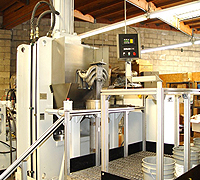
Using abrasive flow machining, Extrude Hone AFM directs a flexible abrasive media through the workpiece so that the finishing action can reach internal surfaces without requiring direct access with a conventional cutting tool.
For automotive, aerospace, medical, hydraulic, and advanced manufacturing applications, this can solve internal deburring problems that are otherwise labor-intensive or inconsistent.
Why Internal Burrs Are Challenging
 Most machining processes can leave some form of burr.
The difficulty is determined as much by location as by burr size.
A relatively small burr on an exposed edge may be easy to remove. The same burr at an internal intersection can be far harder to reach.
Cross-drilled passages are a common example.
When the secondary passage breaks into the primary passage, unwanted material may remain at the intersection.
AFM approaches that burr through the connected flow path.
Abrasive Flow Deburring
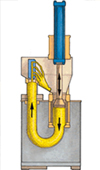
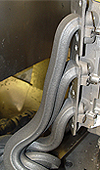 During AFM, abrasive particles are suspended in a polymer media and directed through selected areas of the component.
The media conforms to the internal geometry.
As it passes over a protruding edge, material is removed.
The process can be used for:
- Cross-hole deburring
- Internal edge radiusing
- Passage smoothing
- Manifold finishing
- Hydraulic components
- Automotive passages
- Aerospace parts
- Precision tooling
Columbus Manufacturing Applications
Columbus and central Ohio support significant automotive, aerospace, medical, electronics, logistics, and advanced manufacturing activity.
Ohio's broader manufacturing supply chain also includes component producers working with engines, fluid control systems, hydraulic equipment, and industrial machinery.
Complex machined components in these applications may contain many internal passages.
When internal burr removal cannot be performed efficiently using brushes or rigid tools, Extrude Hone AFM can evaluate AFM as a specialized finishing solution.
Controlled Finishing, Not Random Abrasion
Abrasive media must be directed intentionally.
Extrude Hone AFM designs tooling and selects processing conditions based on the target area.The workpiece material, burr geometry, passage dimensions, required radius, and desired surface condition all help determine the process.
This allows AFM to focus material removal where it is useful while preserving required component geometry.
Production Repeatability
For manufacturers producing the same part repeatedly, AFM can reduce dependence on difficult hand operations.
Once a process has been established, identical components can receive controlled treatment of the same internal features.
This makes flow deburring suitable for both specialized components and repeat production requirements.
Extrude Hone AFM has been applying abrasive flow machining for internal deburring and polishing across dozens of industries since 1971.Call (562) 531-2976 to discuss Columbus, OH flow deburring and request a quote.
FAQs
Can AFM remove burrs in automotive passages?
Yes. Automotive fuel and air passages are established applications for abrasive flow machining.
Can AFM deburr and polish in the same operation?
Depending on the application, the abrasive action can both condition edges and improve the surfaces along the media flow path.
Can Columbus manufacturers send components to Extrude Hone AFM?
Yes. Extrude Hone AFM serves customers nationwide from its facility in Paramount, California.