Abrasive flow machining is especially effective where hydraulic passages intersect inside the workpiece and conventional deburring tools cannot reach them consistently.
The Internal Deburring Problem
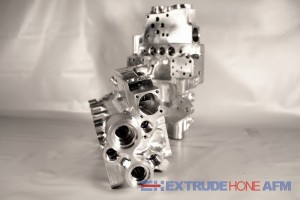
Hydraulic manifolds often contain a dense network of drilled passages.
Every intersection creates an opportunity for a burr.
These edges can be extremely difficult to see or touch after machining.
Traditional deburring may therefore leave microscopic material in internal areas.
Extrude Hone AFM notes that burrs remaining inside hydraulic passages may break free during operation, especially under high pressure, creating contamination that can contribute to premature failure.How AFM Solves the Access Problem
 Abrasive flow machining uses pressure to move abrasive-laden polymer media through selected portions of the component.
The media conforms to the internal geometry.
As it travels over a burr or sharp edge, abrasive particles remove material.
This can allow AFM to:
- Deburr internal intersections
- Radius cross holes
- Smooth passage surfaces
- Reach complicated manifold geometry
- Treat multiple connected features
- Provide repeatable internal finishing
Highly Complex Valve Bodies
Extrude Hone AFM specifically addresses hydraulic valve bodies with more than 100 intersecting holes.Through custom fixture design, media can often be routed through many of these holes so that a majority of intersections are deburred and radiused during the same processing sequence.
This can make AFM far more practical than attempting to reach each feature individually.
Dallas-Fort Worth Hydraulic Applications
DFW supports aerospace, defense, transportation, industrial machinery, manufacturing, energy equipment, and heavy vehicles.
Hydraulic manifolds and fluid-control components may be used throughout these applications.
Aerospace hydraulic parts in particular can combine tight tolerances with complicated passage networks.
AFM originated as an internal finishing process for applications where hand deburring was impossible or inconsistent, making it well suited to this type of work.
Controlling the Amount of Material Removed
Tooling is one of the primary controls in AFM.
It directs media toward the target passages while protecting other surfaces.
Additional variables include:
- Media pressure
- Viscosity
- Abrasive concentration
- Abrasive particle size
- Flow rate
- Component geometry
Working to Blueprint Requirements
AFM can produce controlled radii rather than simply breaking off a burr.
Extrude Hone AFM states that its hydraulic process can improve surface finish and target desired radii while staying within specified tolerances when proper communication and planning occur before production.Repeatable Production Results
Once an AFM process is established, Extrude Hone AFM can monitor stock removal, surface-finish improvement, and radius generation.
This can support production quantities where consistent internal finishing is required from part to part.
Request Dallas Hydraulic Deburring
Call (562) 531-2976 to discuss hydraulic component deburring for Dallas, TX with Extrude Hone AFM.
FAQs
Can AFM deburr aerospace hydraulic parts?
Yes. Complex aerospace hydraulic components are among the applications well suited to AFM.
Can AFM protect surfaces that should not be altered?
Yes. Custom tooling directs media and protects non-target areas.