Abrasive flow machining can reach hidden cross-hole intersections by moving abrasive media through the component itself.
Cross-Drilled Passages and Internal Burrs
Hydraulic components frequently contain channels drilled from different directions.
When one passage breaks through into another, the machining process creates an internal edge.
A burr may remain at this location even after conventional finishing.
The problem becomes more difficult as the number of passages increases.
Extrude Hone AFM explains that incomplete traditional deburring can leave microscopic burrs that later break free during operation and create contamination.AFM is designed to reach those hidden features.
How Hydraulic AFM Works
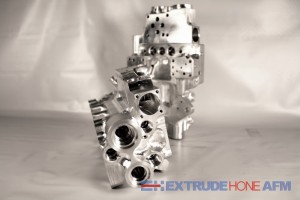 Abrasive particles are suspended inside a flexible polymer carrier.
Hydraulic pressure moves this media through selected internal pathways.
Because the carrier conforms to the passage, it can reach intersections that a rigid tool cannot.
AFM may provide:
- Burr removal
- Cross-hole finishing
- Edge radiusing
- Surface smoothing
- Manifold passage finishing
- Treatment of several connected features
- Repeatable results
Complex Hydraulic Bodies
Extrude Hone AFM's hydraulic FAQ addresses valve bodies containing more than 100 intersecting holes.Purpose-built tooling establishes the flow path and, in many cases, allows a majority of the intersections to be deburred and radiused during the same processing sequence.
This makes AFM useful for dense hydraulic control blocks with many machined channels.
Indianapolis Manufacturing Applications
Indianapolis and central Indiana support automotive, motorsports, aerospace, industrial equipment, agriculture, transportation, and advanced manufacturing.
Hydraulics are used extensively across these sectors.
Manufacturers may produce:
- Automotive hydraulic components
- Industrial manifolds
- Mobile-equipment valves
- Aerospace hydraulic bodies
- Agricultural-equipment components
- Precision fluid-control blocks
AFM can provide internal finishing for each of these applications where the geometry is suitable.
Keeping Burr Removal Controlled
The goal is to eliminate unwanted material without changing important geometry unnecessarily.
Extrude Hone AFM controls the process using tooling, pressure, media viscosity, abrasive concentration, abrasive particle size, and other variables.Available pressure ranges and media options allow the process to be adapted from relatively fine finishing to more aggressive stock removal.
Passage Restriction and Material Removal
The AFM process naturally removes more material where the media path becomes restrictive.
Extrude Hone AFM's process guidance explains that increased flow speed and pressure in these areas increase the local removal rate.Tooling can take advantage of this effect and focus media where deburring or radiusing is needed.
Repeatable Results
Once process parameters are established, stock removal and radius generation can be monitored so identical parts receive consistent treatment.
That can benefit both motorsports-related specialty manufacturing and larger OEM production.
Request Indianapolis Hydraulic Deburring
Call (562) 531-2976 to discuss hydraulic component deburring for Indianapolis, IN with Extrude Hone AFM.
FAQs
Can AFM deburr automotive hydraulic parts?
Yes. Suitable manifolds, control bodies, and internal hydraulic passages can be evaluated for the process.
Can AFM process many internal holes simultaneously?
Often, yes, depending on how custom tooling can establish media flow through the component.
Does Extrude Hone AFM serve Indianapolis?
Yes. Extrude Hone AFM provides hydraulic finishing services nationwide.