Abrasive flow machining can access internal passages, cavities, and irregular geometry by using flexible abrasive media rather than a rigid polishing tool.
For aerospace, industrial, transportation, fluid-handling, and other precision applications, this can make difficult internal polishing both practical and repeatable.
How AFM Polishes Complex Components
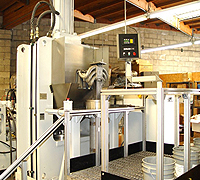 Abrasive flow machining uses a polymer media containing abrasive particles.
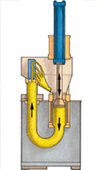
The media is hydraulically forced through a selected section of the workpiece.
As it flows, the media conforms to the geometry and removes raised surface features.
Where the passage becomes restricted, media velocity and pressure can increase, producing more aggressive material removal in those areas.
Extrude Hone AFM uses tooling and process controls to direct this effect toward the surfaces requiring treatment.When Conventional Polishing Is Not Practical
Traditional polishing equipment needs room to operate.
An internal channel several inches inside a component may not provide that room.
A curved or irregular passage creates an even greater challenge.
AFM is particularly useful for these restricted-access areas because the polishing medium moves with the shape of the workpiece.
Applications may include:
- Aerospace passages
- Hydraulic components
- Pump and turbine parts
- Automotive flow paths
- Precision tooling
- Dies and molds
- Additive-manufactured channels
Supporting Southern Nevada Manufacturing
 Las Vegas and Southern Nevada support growing aerospace, industrial, electronics, transportation, and precision manufacturing sectors.
Companies producing complex metal parts may need specialized finishing after machining, EDM, casting, or additive manufacturing.
Extrude Hone AFM can provide that finishing without requiring the manufacturer to purchase AFM equipment or develop its own media and tooling.Typical Surface Improvements
The amount of improvement varies by component.
Extrude Hone AFM lists examples including approximately 16–8 Ra improved to 3–4 Ra and 32 Ra improved to 8 Ra or better.Other examples include 64 Ra improved to around 16 Ra or better and 125 Ra improved to approximately 63 Ra or better.
These results depend heavily on passage geometry and material.
An evaluation of the actual component is required to establish realistic expectations.
Materials Suitable for Flow Polishing
AFM can polish soft and hard metals.
Suitable materials may include aluminum, bronze, copper, titanium, Inconel, superalloys, and hardened metals.
The abrasive and media formulation can be chosen according to the characteristics of the workpiece.
Consistency Across Repeat Parts
Once Extrude Hone AFM establishes tooling and processing variables for a component, AFM can provide a repeatable approach to internal polishing.
This is useful when difficult manual finishing would otherwise need to be repeated on every part.
Call (562) 531-2976 for a Las Vegas, NV flow polishing quote.
FAQs
Can AFM polish parts made through additive manufacturing?
Yes. Improving critical internal passageways in suitable additive-manufactured components is an established AFM application.
Can AFM polish both soft and hard metals?
Yes. The process can be adapted to a wide range of metal materials.