AFM is particularly useful when the surfaces that matter most are inside the component. Aerospace parts, automotive passages, hydraulic components, medical devices, dies, molds, pumps, and other precision parts may contain internal geometry that cannot be polished consistently by hand.
How Flow Polishing Works
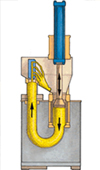
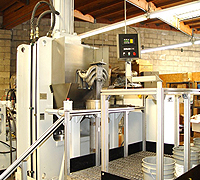 During abrasive flow machining, a viscoelastic polymer media containing abrasive particles is forced through or across the area that requires finishing.
The media behaves like a flexible polishing tool. Rather than maintaining a fixed shape, it conforms to the geometry of the passage through which it travels.
As the abrasive media contacts raised surface features, it gradually removes material and smooths the workpiece.
Material removal tends to be greater where the media encounters restrictions because flow speed and pressure increase in those areas. Tooling is designed to direct the media toward surfaces requiring work while protecting areas where polishing is not desired.
Why Use AFM for Internal Polishing?
Conventional polishing methods can work well when the surface is exposed and easily accessible. Internal features create a much different challenge.
Flow polishing can provide:
- Improved internal surface finish
- Access to complex passages and cavities
- Uniform finishing of difficult geometry
- Reduced dependence on hand polishing
- Controlled removal of raised surface features
- Repeatable processing for production parts
- Simultaneous deburring and edge conditioning where required
The precise result depends on the starting finish, material, geometry, abrasive media, and project requirements.
Flow Polishing for Los Angeles Manufacturing
 Los Angeles and Southern California support extensive aerospace, automotive, medical technology, electronics, defense, and precision manufacturing activity.
Many components used in these industries depend on internal airflow, fluid flow, cleanliness, or precise surface conditions. Roughness inside a passage can matter even when that surface is invisible after assembly.
Extrude Hone AFM has applied AFM to high-performance fuel and air passages, hydraulic systems, medical components, precision tooling, pumps, turbines, and other demanding applications.Surface Finish Improvement
AFM can produce significant surface improvements in suitable applications.
Examples listed by Extrude Hone AFM include improving approximately 16–8 Ra surfaces to 3–4 Ra and approximately 32 Ra surfaces to 8 Ra or better. Other starting finishes can also be improved.
These figures should not be interpreted as a guaranteed result for every part. Final finish depends on the workpiece material, initial condition, geometry, and accessibility of the surface.
Extrude Hone AFM can evaluate the component and determine what result is realistic.Materials Suitable for AFM
Abrasive flow machining can be applied to a wide variety of metals, including difficult-to-machine materials such as titanium, Inconel, superalloys, and hardened metals as well as aluminum, bronze, copper, and other softer metals.
Process variables are selected according to both the material and desired finish.
Request a Flow Polishing Quote
If internal surfaces on your Los Angeles, CA components require polishing, Extrude Hone AFM can review the material, geometry, starting surface, and required result to determine whether AFM is appropriate.
Call (562) 531-2976 to discuss your flow polishing application and request a quote.
Flow Polishing FAQs
Can AFM polish surfaces that cannot be reached by hand?
Yes. Access to complex internal geometry is one of the principal advantages of abrasive flow machining.
Can AFM create a very smooth finish?
AFM can substantially improve surface finish and can produce very fine finishes in suitable applications. The achievable result depends on the component.