Abrasive flow machining improves internal manifold passages using a flexible polymer media containing abrasive particles.
The media moves through each selected runner under pressure, allowing it to smooth difficult internal surfaces without relying entirely on direct access with conventional porting tools.
Why the Intake Manifold Is Important
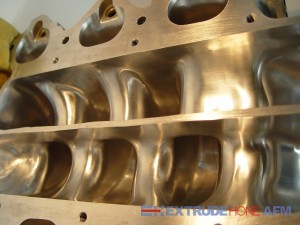 Airflow into the cylinders is one of the fundamental limits on engine performance.
The intake manifold plays a major role in that process.
Even a well-designed manifold may contain casting roughness, uneven internal surfaces, burrs, or restrictive transitions.
Porting seeks to improve those conditions.
Extrude Hone AFM identifies the intake manifold as one of the best individual automotive components to consider for AFM when improving engine flow is the goal.How AFM Improves Intake Runners
Hydraulic pressure moves abrasive media through the manifold.
Because the polymer is flexible, it follows the existing runner shape.
Abrasive particles work against the internal walls and remove material from high spots and restrictions.
This allows the process to reach:
- Long runners
- Curved passages
- Internal transitions
- Areas hidden from conventional tools
- Multiple passages requiring similar treatment
Intake Manifold Porting vs. Hand Porting
Traditional porting often involves grinding or sanding accessible areas by hand.
The process can work well, but deep runners and enclosed manifold designs may limit access.
AFM follows the entire flow pathway instead.
This can provide more uniform finishing where a technician cannot maintain direct contact with every surface.
Extrude Hone AFM's existing porting pages emphasize this difference between hand access and conformable abrasive media.Potential Flow and Performance Gains
Extrude Hone AFM reports intake-manifold flow improvements of up to approximately 25 percent in suitable applications.Improved flow may help support:
- Better volumetric efficiency
- Increased horsepower
- Improved torque
- More efficient cylinder filling
- Improved combustion
These benefits are application-dependent.
An intake manifold operates as part of a larger system, so engine performance will also depend on heads, camshaft, exhaust, fueling, induction, displacement, and tuning.
Nashville Automotive Applications
Nashville and Middle Tennessee have a substantial automotive manufacturing presence, along with performance shops, restoration, racing, and custom vehicle communities.
AFM may be relevant for:
- Performance street builds
- Racing engines
- Production automotive components
- Restorations
- Turbocharged engines
- Diesel applications
- Custom manifold designs
It can also be useful where a specific intake manifold must be retained because no better aftermarket alternative exists.
Material-Specific Porting
Modern manifolds are often aluminum, while some older or specialty components may be cast iron.
Extrude Hone AFM can adjust abrasive size, media formulation, pressure, and tooling according to the material.The goal is controlled surface improvement appropriate to the specific workpiece.
Repeatability for Manufacturers and Builders
Once a process is developed, Extrude Hone AFM can reproduce the same conditions on similar components.
That repeatability can be useful for manufacturing, matched components, or builders seeking consistent internal finishing.
Request Nashville Intake Manifold Porting
Call (562) 531-2976 to discuss your Nashville, TN intake manifold with Extrude Hone AFM.
FAQs
Is intake manifold porting only for racing engines?
No. Racing is a common application, but any suitable performance, restoration, or specialty engine may benefit.
Can AFM process diesel intake components?
Potentially, yes. Diesel engines are among Extrude Hone AFM's established automotive applications.
Does Extrude Hone AFM serve Nashville?
Yes. Extrude Hone AFM serves automotive customers nationwide.