Abrasive flow machining uses a flexible abrasive media that moves through internal geometry, allowing Extrude Hone AFM to polish passages and surfaces that may be inaccessible to conventional polishing equipment.
For Phoenix-area aerospace, semiconductor, medical, and advanced manufacturing applications, AFM can be particularly useful when both precision and internal access matter.
Improving Surfaces Inside the Part
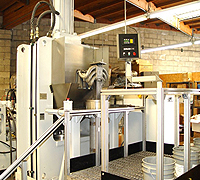 Many modern components are engineered from the inside out.
Cooling channels, fluid passages, internal manifolds, and intricate cavities may be essential to performance even though they cannot be reached after the component is assembled or machined.
Conventional surface finishing tools generally require direct access.
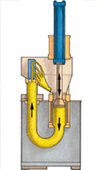
AFM uses the internal passage as the route for the finishing media.
As abrasive polymer media travels through the workpiece, it smooths raised surface features along the flow path.
Semiconductor and Precision Applications
Phoenix has become an important center for semiconductor manufacturing as well as aerospace and other advanced industries.
Components used in semiconductor processing and ultrapure fluid systems may require carefully controlled internal surfaces. Small burrs, cavities, or rough features can be undesirable when cleanliness and fluid handling are critical.
Extrude Hone AFM has experience applying AFM to ultrapure fluid-handling applications as well as aerospace, medical, hydraulic, and other precision components.Benefits of Flow Polishing
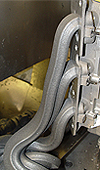 Depending on the part, abrasive flow machining can provide:
- Smoother internal passages
- Reduced surface roughness
- Improved uniformity
- Access to complex or restricted geometry
- Internal deburring
- Controlled edge radiusing
- Repeatable finishing for production parts
The process can also be tailored to focus abrasion on selected areas.
How Tooling Controls AFM
Tooling performs an important role in abrasive flow polishing.
It supports the component, directs media toward surfaces requiring treatment, and can protect other areas where abrasive action is not desired.
This makes it possible to focus the process rather than exposing every surface to identical polishing.
Typical Finish Improvements
Extrude Hone AFM lists examples of AFM improving 16–8 Ra surfaces to approximately 3–4 Ra and 32 Ra surfaces to 8 Ra or better.For rougher surfaces, improvements such as 64 Ra to 16 Ra or better may also be possible.
These are representative results rather than guarantees.
Actual finish depends on the geometry, workpiece material, starting condition, and process developed for the application.
Compatible Materials
AFM can be applied to a wide variety of metals, including aluminum and copper as well as titanium, Inconel, superalloys, and hardened materials.
This makes it useful across both semiconductor equipment and aerospace manufacturing.
Request Phoenix Flow Polishing
If your Phoenix, AZ component contains an internal surface that needs polishing, Extrude Hone AFM can evaluate the part and help determine the appropriate AFM approach.
Call (562) 531-2976 to request a quote.
FAQs
Can AFM polish semiconductor fluid-handling components?
Yes, suitable ultrapure fluid-handling components are among the applications for abrasive flow machining.
Can AFM polish additive-manufactured passages?
Yes. Surface finishing of critical passageways in appropriate additive-manufactured parts is an established AFM application.