Abrasive flow machining uses a flexible, abrasive-filled polymer media to work on surfaces inside components such as intake manifolds and other fuel or air pathways.
Because the media follows the actual passage geometry, it can finish areas that may be difficult to address uniformly through hand porting.
How the Automotive AFM Process Works
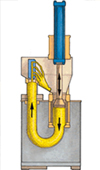
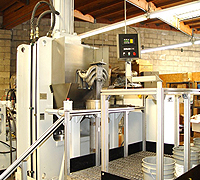 Hydraulic pressure pushes abrasive media through the engine component.
Abrasive particles remain suspended in the media as it travels around bends and through restrictions.
The process gradually removes material from raised internal features while smoothing the passage.
Extrude Hone AFM can adjust the process through:- Media formulation
- Abrasive particle size
- Abrasive concentration
- Pressure
- Tooling
- Processing cycles
- Workpiece material
These variables allow the process to be matched to the individual component.
Automotive Components for AFM
Common applications may include:
- Intake manifolds
- Exhaust manifolds
- Turbo impellers
- Turbo housings
- Pumps
- Cylinders
- Internal air passages
- Fuel passages
Intake manifolds are particularly common because of their importance to engine breathing.
Extrude Hone AFM identifies the intake manifold as the component most likely to provide a meaningful improvement when a customer chooses only one part to extrude hone.Potential Automotive Benefits
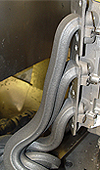 Extrude Hone AFM reports that automotive AFM can improve fuel and air flow by up to 25 percent in suitable applications.
Improved internal flow may contribute to:
- Better volumetric efficiency
- Increased horsepower
- Improved torque
- More complete cylinder filling
- Better evacuation between combustion cycles
- More efficient combustion
The exact gains depend on the engine and should be viewed as application-dependent.
Pittsburgh Performance and Restoration Applications
Pittsburgh has a long automotive and industrial history, with performance shops, classic-car enthusiasts, specialty machinists, race applications, and custom builders throughout the region.
AFM can be particularly valuable for older or rare manifolds and other components where an aftermarket replacement is not available.
It can also complement conventional engine machining when builders want to address internal passage quality beyond what hand tools can reach.
Working With Different Metals
Extrude Hone AFM can vary the abrasive approach according to material.Company guidance specifically notes that an aluminum component can use a lighter abrasive while cast iron may require a more aggressive formulation.
This flexibility allows AFM to serve a wide variety of automotive parts.
Repeatability and Matching
Once Extrude Hone AFM determines an appropriate tool, grit, media, and pressure, the process can be repeated.
That can help improve consistency between multiple components or runners.
Call (562) 531-2976 to discuss automotive AFM for Pittsburgh, PA.
FAQs
Is AFM suitable for classic-car components?
Potentially, yes. Rare or difficult-to-replace engine components may be evaluated individually for process suitability.
Can AFM improve turbo components?
Yes. Turbo impellers and housings are among the automotive parts identified for AFM.