Abrasive flow machining is especially useful where surface finishing is required inside geometry that conventional polishing tools cannot reach efficiently.
By moving flexible abrasive media through the workpiece, Extrude Hone AFM can improve the internal finish while controlling where material removal occurs.
Why Use Flow Polishing?
Machining, casting, EDM, and additive manufacturing can all leave surfaces that require further finishing.
External surfaces may be relatively easy to grind, polish, or hone.
An internal cavity or convoluted passage is different.
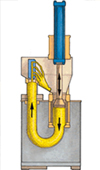
AFM allows the abrasive medium to conform to the feature rather than requiring a rigid tool that matches the entire internal shape.
This gives manufacturers another option for difficult finishing applications.
Applications for Pittsburgh Manufacturers
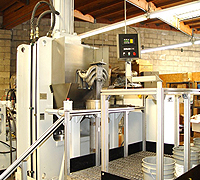 The Pittsburgh region supports advanced materials, energy, robotics, medical technology, aerospace, industrial machinery, and precision manufacturing.
Components in these industries may contain:
- Hydraulic passages
- Pump and turbine surfaces
- Aerospace flow paths
- Precision dies and molds
- Medical component features
- Additive-manufactured channels
- Complex industrial passages
How Much Can the Surface Improve?
The answer depends on the part.
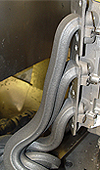 Representative finish improvements published by Extrude Hone AFM include 16–8 Ra surfaces improved to approximately 3–4 Ra, 32 Ra surfaces to 8 Ra or better, and 64 Ra surfaces to 16 Ra or better.
Rougher surfaces may also see substantial improvement.
However, material hardness, geometry, starting roughness, flow restriction, abrasive selection, and process conditions all affect the final result.
Working With Difficult Materials
The ability to finish hard metals is especially relevant to aerospace and industrial manufacturing.
Extrude Hone AFM can use AFM on titanium, Inconel, superalloys, and hardened materials as well as aluminum, bronze, copper, and other softer metals.Media characteristics can be selected according to the material and desired finishing intensity.
Tooling Keeps the Process Focused
AFM tooling does more than hold the part.
It directs the abrasive media toward the surfaces requiring polishing and protects areas where abrasive action is not desired.
This helps Extrude Hone AFM develop a controlled flow path instead of simply exposing the entire workpiece to media.
Repeatable Surface Finishing
For production applications, repeatability can be just as important as the finish on the first component.
Once tooling and process variables have been established, AFM can provide controlled treatment of identical internal geometry across repeated parts.
This can reduce the variability and labor associated with difficult manual polishing.
Call (562) 531-2976 to discuss Pittsburgh, PA flow polishing and request a quote.
FAQs
Can AFM polish dies and molds?
Yes. Precision dies and molds are established applications for abrasive flow machining.
Can AFM process Inconel?
Yes. Inconel and other difficult-to-machine superalloys can be processed using AFM.