Abrasive flow machining provides a controlled way to improve internal runner surfaces by moving abrasive-filled polymer media through the intake manifold.
Because the media conforms to bends and enclosed passages, AFM can reach areas that may be inaccessible using conventional grinders and hand-porting tools.
What Porting Addresses
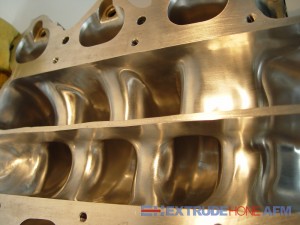 Intake manifolds may contain:
- Casting roughness
- Uneven surfaces
- Abrupt transitions
- Burrs
- Narrow internal regions
- Runner-to-runner variation
These conditions can create unnecessary airflow restriction.
AFM helps refine the passage from within.
The process is not simply intended to make the largest possible opening. The objective is to improve the internal flow path while maintaining geometry appropriate for the engine.
Why Use AFM?
Traditional porting is limited by direct access.
The technician needs room to guide a cutting or abrasive tool over the target surface.
That can be difficult in enclosed intake-manifold runners.
AFM allows abrasive media to flow through the runner and contact surfaces continuously.
Existing Extrude Hone AFM porting guidance describes this as a more uniform way to improve complete passages and reduce the risk of uneven internal finishing.
Potential Airflow Improvement
In suitable intake-manifold applications, Extrude Hone AFM reports flow increases of up to approximately 25 percent.
Improved intake flow may contribute to:
- Better volumetric efficiency
- Increased horsepower
- Improved torque
- Better cylinder filling
- More effective combustion
These results depend on the entire engine.
An improved manifold cannot overcome every restriction elsewhere in the system, so Extrude Hone AFM does not promise specific horsepower or fuel-economy gains.
Pittsburgh Performance and Restoration Applications
Pittsburgh's automotive community includes performance vehicles, classic cars, muscle cars, motorsports, restoration, diesel work, custom fabrication, and specialty machining.
Intake manifold porting can be particularly useful for older engines where an original or rare manifold must be retained.
A vintage cast-iron intake, for example, may have significant internal roughness while being too valuable or difficult to replace.
AFM provides one possible way to improve that component while preserving the overall design.
Aluminum and Cast Iron
Different manifold materials require different processing strategies.
Existing Extrude Hone AFM guidance specifically notes that aluminum can use a lighter abrasive while cast iron may call for a heavier formulation.
The media, pressure, abrasive size, and number of cycles are all adjusted around the workpiece.
Material Removal and Process Control
For automotive flow applications, Extrude Hone AFM notes that material removal may reach approximately .040 inch, or 1 millimeter, where appropriate.
Actual removal depends on geometry and performance goals.
The intention is controlled improvement, not indiscriminate enlargement.
Repeatability
AFM parameters can be reproduced once a successful process is developed.
This can be useful for matching similar manifolds or processing multiple production components.
Call (562) 531-2976 to discuss intake manifold porting for Pittsburgh, PA.
FAQs
Can AFM port an old cast-iron manifold?
Potentially, yes. Cast-iron components can be processed with an appropriately selected abrasive strategy.
Can AFM reach internal bends?
Yes. The flexible media follows the runner geometry.