Abrasive flow machining is particularly useful for industrial components whose functional surfaces cannot be reached consistently with conventional grinding or polishing equipment.
Pump Surface Finish and Efficiency
The efficiency of a centrifugal pump depends on more than its basic dimensions.
Fluid must move across the impeller and through the housing.
Rough surfaces and positive material buildup can create drag.
Extrude Hone AFM specifically states that poor internal surface finish can slow the volume of fluid pumped through the system. AFM can improve the relevant surfaces and support increased pump efficiency and reduced motor stress.How AFM Works on Turbine and Pump Components
 A hydraulic ram forces abrasive-filled polymer media through the selected component geometry.
The media molds itself to the available passage.
Abrasive particles contact raised surface features and remove them.
Potential applications include:
- Impellers
- Pump housings
- Turbine components
- Blade passages
- Internal fluid channels
- Gas-flow passages
- Restricted transitions
- Additive-manufactured flow paths
Pittsburgh Industrial Applications
Pittsburgh has deep roots in heavy industry and continues to support advanced manufacturing, energy, power systems, robotics, materials processing, industrial equipment, water systems, and precision machining.
Pumps and turbines used throughout these sectors may face demanding service conditions.
Manufacturers and rebuilders may need to improve flow paths while preserving the component's fundamental geometry.
AFM can provide controlled finishing for those applications.
Restricted Blade Geometry
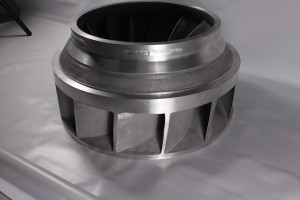
Impellers and turbine components can contain tightly spaced, curved blades.
These areas are difficult to reach with standard polishing equipment.
Extrude Hone AFM emphasizes that AFM can remove material from even the most restricted areas between blades and provide uniform finishing throughout the component.This capability can be especially valuable for small or intricate industrial components.
Geometry Optimization
Extrude Hone AFM's broader AFM content specifically identifies turbines and pumps as applications where internal passage geometry can be optimized to improve fluid and gas behavior.AFM works preferentially on raised features and areas of restriction.
That makes it possible to improve the flow path without indiscriminately removing the same amount of material from every location.
Finishing Additive-Manufactured Components
Advanced manufacturers increasingly use metal additive processes for impellers, turbines, and other complex components.
These processes can create shapes that conventional machining cannot, but the resulting internal surfaces may remain rough.
Extrude Hone AFM has specifically applied AFM to additive-manufactured turbines and pumps because their internal passages often cannot be polished by conventional methods.Controlled Process Variables
Material removal depends on:
- Workpiece material
- Hardness
- Passage dimensions
- Media-flow rate
- Media viscosity
- Abrasive particle size
- Abrasive concentration
Surface Finish Improvement
Representative improvements include approximately 32 Ra to 8 Ra or better and 64 Ra to 16 Ra or better.
Hard materials such as titanium, Inconel, and superalloys can also be processed.
Request Pittsburgh Turbine and Pump Finishing
Call (562) 531-2976 to discuss turbine and pump flow finishing for Pittsburgh, PA with Extrude Hone AFM.
FAQs
Can AFM be used on pumps for heavy industry?
Yes. Suitable pump, impeller, and flow components can be evaluated regardless of the industry in which they operate.
Can AFM finish metal 3D-printed turbine parts?
Yes. Complex additive-manufactured metal passages are an established AFM application.