Through abrasive flow machining, abrasive-laden polymer media can be directed into passages and other restricted features where conventional polishing tools may not provide practical access.
This makes AFM especially relevant to semiconductor, medical technology, aerospace, research, and precision fluid-handling applications common throughout the Bay Area.
Polishing the Surfaces You Cannot Easily Reach
Internal surface finish is sometimes critical even though the surface itself is hidden.
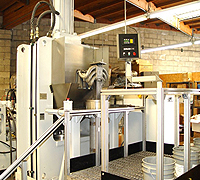 A fluid-handling component may contain narrow internal pathways. An aerospace component may contain cooling or airflow passages. An additive-manufactured part may incorporate complex channels impossible to reach with a polishing wheel or hand tool.
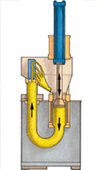
AFM works by moving the polishing media through these pathways.
The media molds itself to the shape of the workpiece and abrades raised surface features along its route.
Bay Area Precision Applications
Semiconductor fabrication, medical technology, advanced electronics, and aerospace manufacturing can place demanding requirements on internal component surfaces.
Ultrapure fluid-handling systems are one example. Microscopic burrs, rough areas, and cavities may be undesirable where contamination control is critical.
Medical applications can similarly benefit from smoother, deburred surfaces.
Extrude Hone AFM has experience applying AFM to both types of components as well as high-performance aerospace and industrial parts.What Flow Polishing Can Accomplish
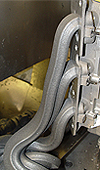 AFM may provide:
- Improved internal surface finish
- Access to restricted and intricate passages
- Removal of raised surface irregularities
- Internal deburring
- Edge radiusing
- Improved consistency
- Repeatable finishing across production components
The finished result is controlled through media selection, tooling, process pressure, flow restrictions, and other variables.
Representative Finish Improvements
Surface improvements depend on the starting point.
Examples published by Extrude Hone AFM include approximately 16–8 Ra improved to 3–4 Ra, 32 Ra improved to 8 Ra or better, and 64 Ra improved to 16 Ra or better.
These figures illustrate what AFM can accomplish in suitable applications but do not guarantee a particular Ra for every component.
Metals and Advanced Materials
AFM is suitable for many metals used in Bay Area precision manufacturing.
These include aluminum and copper as well as harder materials such as titanium, Inconel, hardened alloys, and superalloys.
Workpiece hardness is one factor considered when selecting the media and abrasive characteristics.
Tooling Directs the Polishing Action
Extrude Hone AFM uses AFM tooling to secure the workpiece, direct media through the surface requiring treatment, and protect areas where polishing is not desired.This is particularly important for complex high-value components where only selected surfaces require alteration.
Request Bay Area Flow Polishing
Call (562) 531-2976 to discuss your San Francisco, CA or Bay Area flow polishing application with Extrude Hone AFM. Providing information about material, geometry, starting finish, and target surface requirements will help determine the best approach.
FAQs
Can AFM polish components for ultrapure fluid systems?
Yes. Extrude Hone AFM has applied AFM to ultrapure fluid-handling components used in applications such as semiconductor fabrication.
Is AFM useful for additive-manufactured components?
Yes. Complex passageways in suitable additive-manufactured parts can benefit from AFM surface finishing.