Abrasive flow machining can access internal passages by moving a flexible abrasive polymer through the workpiece.
This makes AFM particularly useful for medical components with lumens, cross holes, channels, or other features that cannot be polished reliably with conventional tools.
Surface Finish in Medical Applications
Medical components may perform several different functions.
Some contact tissue. Others carry fluids, form part of an implant, or operate within diagnostic and drug-delivery systems.
In each case, unwanted burrs and rough internal surfaces may create manufacturing or performance concerns.
Extrude Hone AFM's medical guidance identifies two major benefits of AFM: creating smoother, radiused edges and improving surfaces by reducing microscopic irregularities associated with contamination.Components That May Benefit
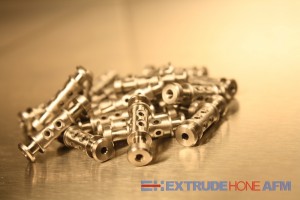 Medical-device AFM can be evaluated for:
- Surgical instruments
- Implantable components
- Orthopedic parts
- Spinal components
- Needles
- Cannulas
- Pumps
- Valves
- Diagnostic systems
- Drug-delivery devices
A recent Extrude Hone AFM medical article specifically describes using AFM to smooth lumens, deburr cross-drilled holes, polish fluid pathways, and radius internal edges.
AFM for Difficult Internal Surfaces
Abrasive flow machining uses hydraulic force to move abrasive media through selected passages.
The media is flexible and changes shape to match the workpiece.
As it flows, abrasive particles contact raised positive surface features and remove material.
This provides access to complex internal surfaces without requiring a rigid tool to follow every bend.
New York Medical Technology and Manufacturing
New York City and the larger metropolitan region support medical technology, biotechnology, diagnostics, healthcare research, precision manufacturing, and specialized engineering.
Device developers may require small production runs during development and larger quantities after commercialization.
AFM can be applied to both specialized components and repeat production where geometry and specifications make the process appropriate.
Internal Fluid Flow
Needles, cannulas, pumps, valves, and delivery devices may depend on carefully controlled internal pathways.
Surface roughness can affect flow, and microscopic cavities may provide areas where unwanted material accumulates.
Extrude Hone AFM's broader surface-finish guidance explains that peaks and valleys left by machining can affect fluid flow and contribute to contamination concerns.AFM can improve these surfaces by reducing raised features.
Selective Process Control
Not every surface of a medical component should necessarily receive abrasive treatment.
AFM tooling can direct media specifically to the passage requiring improvement while protecting other areas.
Media viscosity, pressure, abrasive size, concentration, and flow rate can then be adjusted according to the desired result.
Repeatability Across Production Lots
Once an effective AFM process is established, Extrude Hone AFM can monitor surface-finish improvement, radius generation, and stock removal to support repeatability.
This is particularly useful when manufacturers need consistent internal finishing across multiple components.
Request New York Medical Device Surface Finishing
Call (562) 531-2976 to discuss New York, NY medical-device components with Extrude Hone AFM.
FAQs
Can AFM polish internal needles or cannulas?
Suitable internal passages in needles, cannulas, and related components can be evaluated for AFM.
Can AFM create a smooth edge instead of just removing a burr?
Yes. Controlled edge radiusing is one of AFM's established medical applications.
Does Extrude Hone AFM serve New York manufacturers?
Yes. Extrude Hone AFM accepts components from customers throughout the United States.